
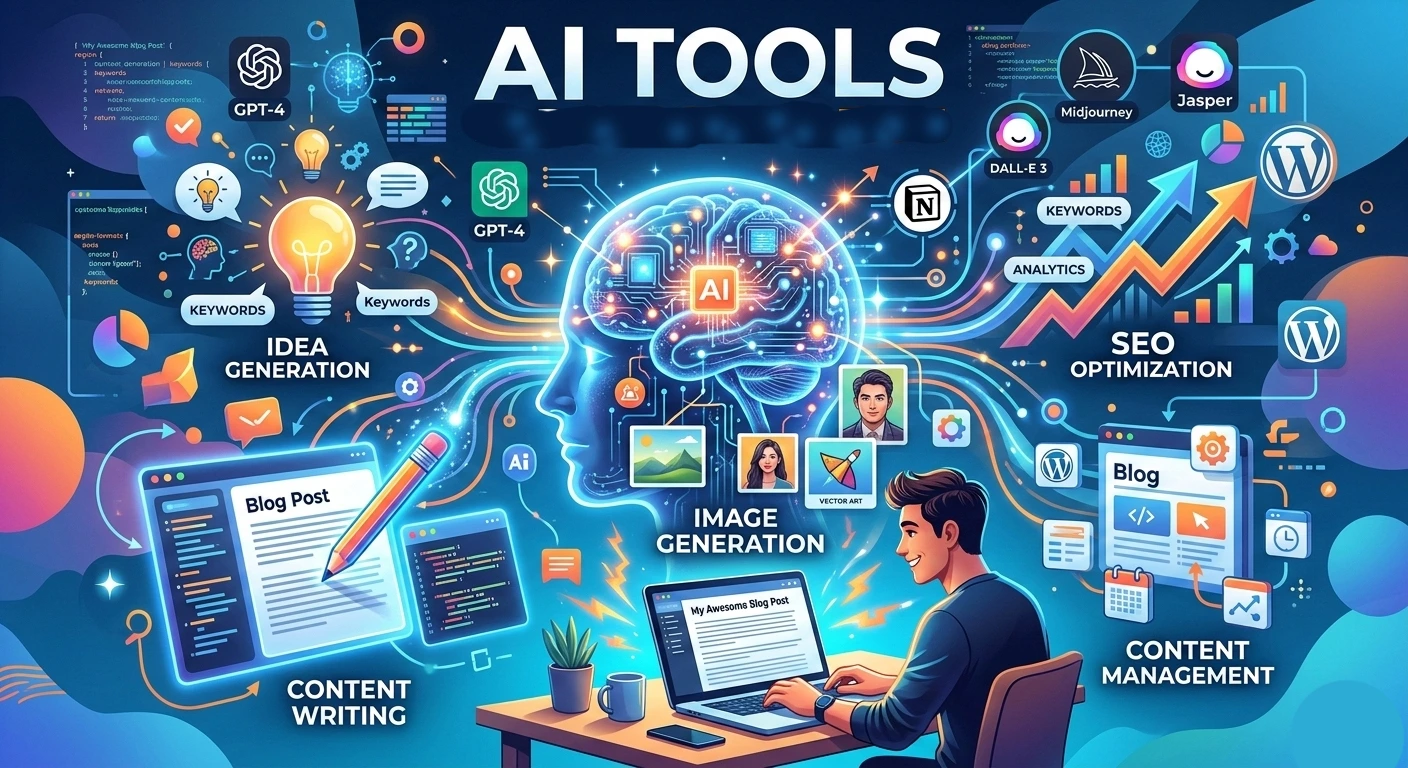
The era of paying a premium for digital productivity is officially over. For years, we accepted that a $20/month subscription to ChatGPT Plus, a monthly fee for Canva, and separate payments for note-taking apps and music generators were just the cost of doing business in the digital age. However, as we navigate through 2026, the landscape has shifted dramatically. The gap between paid “Pro” tiers and free services has not just narrowed; in many cases, it has vanished entirely.
The most significant trend of 2026 isn’t a single groundbreaking AI model—it is the ambient integration of AI into our daily routines. According to industry analysts, we are witnessing a shift from standalone AI novelties to embedded utilities that function more like electricity than software. As Forrester notes, AI has lower barriers to entry than mobile technology did, with 38% of US consumers already using generative AI and most doing so weekly. This proliferation has led to a fierce battle for your attention, and the primary weapon is now free, high-quality utility. Whether it is Google leveraging its ecosystem to offer agentic behavior for free or open-source platforms distributing compute power through “underground networks,” the message is clear: you can now replace your expensive daily apps with superior, cost-free alternatives.
Below, we dive into the top 7 free AI tools in 2026 that are so powerful, they might just make you hit “cancel subscription” on your current favorites.
1. Google Gemini
Website: gemini.google.com
What is the Power of This Tool?
Google Gemini is not just a chatbot; it is a full-scale AI ecosystem that lives inside your Google account. Its defining power is the 2 million token context window, which is currently the largest available on the market for free. This means you can upload an entire trilogy of novels, a full software codebase, or a two-hour lecture video, and Gemini will recall and analyze every single detail. It doesn’t just read text; it watches videos, listens to audio, and interprets images simultaneously.
Furthermore, its power lies in native integration. Because it is built by Google, it connects directly to Gmail, Google Maps, YouTube, and Google Drive without requiring plugins or third-party access. You can ask it to summarize your unread emails from the past week, find the restaurant you searched for last month, and then draft a reply email—all within one interface. It replaces dedicated productivity apps, email sorting tools, and even basic project management software by making your existing Google data work for you.
What Daily App Does It Replace?
It replaces ChatGPT Plus subscriptions, Evernote (for note organization), Todoist (for task management), and Canva (for basic image generation via Lyrica 3).
2. Perplexity AI
Website: perplexity.ai
What is the Power of This Tool?
Perplexity redefines how we consume information. Its primary power is real-time, cited research synthesis. Unlike traditional search engines that return a list of links, Perplexity acts as a research assistant. It scours the live internet, reads dozens of articles, and compiles them into a single, coherent answer with footnotes. For students and professionals, this turns a two-hour research session into a five-minute verification process.
The platform also introduces “Deep Research” capabilities in its free tier, allowing it to perform multi-step research tasks. You can ask complex questions that require comparing statistics from different years or analyzing competing claims, and Perplexity will return a structured report. It also supports file uploads, meaning you can upload a PDF and ask it to find recent statistics online that either support or contradict the document. This replaces the need for academic databases and manual cross-referencing.
What Daily App Does It Replace?
It replaces Google Search (for research), academic journal subscriptions, and news aggregator apps.
3. Claude (by Anthropic)
Website: claude.ai
What is the Power of This Tool?
Claude’s power lies in its nuanced reasoning and “constitutional” safety. While other AIs might generate content quickly, Claude is known for its thoughtful, almost literary quality of writing. It excels at tasks requiring emotional intelligence, such as editing a novel, crafting a sensitive business email, or providing therapeutic conversation. Its ability to understand tone, subtext, and complex human instructions makes it the go-to tool for writers and communicators.
Technically, its power is its large file handling and artifact system. You can upload up to 20 files—spreadsheets, PDFs, images—in a single conversation, and Claude will analyze them holistically. The “Artifacts” feature allows it to generate code, documents, or visualizations in a separate window that you can edit live. This means you can have Claude build a website, debug the code visually, and then explain the code to you in plain English, all within the same free session. It replaces coding bootcamps and expensive editing software.
What Daily App Does It Replace?
It replaces Grammarly Premium, GitHub Copilot (for coding assistance), and professional editing services.
4. Arena AI ( LMSYS Chatbot Arena)
Website: chat.lmsys.org
What is the Power of This Tool?
The power of Arena AI is unbiased access and model comparison. Run by a collaborative research group (LMSYS), this platform allows you to use multiple state-of-the-art AI models completely free of charge. Its “Battle” mode lets you input a prompt and receive two anonymous responses. You vote on which is better, helping train the ranking system while also giving you the best possible answer to your query. This removes brand bias; you don’t care if the answer came from Gemini or Claude, you just want the best result.
Furthermore, it acts as a unified portal. Instead of maintaining five different accounts for five different AI tools, you can access them all here. Need a quick answer? Use the fast model. Need creative writing? Switch to the creative model. It replaces the need to manage multiple subscriptions and logins, offering a “one-stop-shop” for AI utility.
What Daily App Does It Replace?
It replaces multiple standalone AI subscriptions (ChatGPT, Copilot, etc.) and AI comparison tools.
5. ElevenLabs
Website: elevenlabs.io
What is the Power of This Tool?
ElevenLabs is the gold standard for voice generation and audio cloning. Its power lies in its “Generative Voice AI” which produces speech that is indistinguishable from a human recording, complete with intonation, emotion, and pacing. The free tier offers a generous allocation of characters per month, allowing creators to produce hours of voiceover content without paying a cent.
Its most groundbreaking feature is “Voice Library” and “Projects.” You can clone a voice (with permission) in seconds, or choose from a massive library of community-created voices. The “Projects” feature acts like a full audio workstation: you can write a script, assign different voices to different characters, and export the entire audio file as a podcast or narration. For indie creators, this replaces the need for hiring voice actors, renting studio time, or purchasing expensive audio editing software.
What Daily App Does It Replace?
It replaces Audacity (for complex editing), professional voice actors, and podcast recording software.
6. Hugging Face
Website: huggingface.co
What is the Power of This Tool?
Hugging Face is the “GitHub of AI.” Its power is access and community. It hosts over 500,000 pre-trained models, 200,000 datasets, and 300,000 demo applications (Spaces), all available for free. Whether you need a model that translates ancient languages, generates synthetic medical data, or identifies bird species from a photo, it is almost certainly available on Hugging Face.
For non-developers, the power is in “Spaces.” These are simple demo apps that let you try any model instantly. You want to remove the background from an image? There’s a Space for that. You want to generate a 3D model from a text prompt? There’s a Space for that. It replaces expensive, niche software tools by providing community-built, open-source alternatives that run right in your browser.
What Daily App Does It Replace?
It replaces Adobe Creative Cloud (specific tools like background removal), specialized scientific software, and proprietary data analysis tools.
7. Qwen (by Alibaba Cloud)
Website: tongyi.aliyun.com/qianwen/ (or chat.qwen.ai)
What is the Power of This Tool?
Qwen (通义千问) is a multimodal powerhouse that often flies under the radar. Its primary power is its all-in-one media generation. While Western models often separate text, image, and video generation into different products, Qwen handles them all natively. You can ask it to read a PDF, generate a summary, turn that summary into a storyboard, and then generate a short video based on that storyboard—all in one chat thread.
Its “Deep Research” mode is also exceptionally powerful, capable of generating 15-page, fully cited research reports that rival those from paid academic tools. For business users, it integrates deeply with the Alibaba ecosystem, offering tools for generating marketing copy in multiple Asian languages with cultural nuance that Western models often miss. It replaces expensive multimedia suites and market research tools.
What Daily App Does It Replace?
It replaces RunwayML (for video generation), Midjourney subscriptions, and market research platforms.
Conclusion: The Future is Free (and Invisible)
As we look at the rest of 2026, the trajectory is clear. The most advanced AI is becoming the AI you notice the least. It is moving from a destination (a website you visit) to a utility (a layer over everything you do). The tools listed above are replacing daily apps not by mimicking them, but by making their core functions obsolete. Why maintain a folder of stock photos when you can generate a 4K image on demand? Why pay for grammar checks when your writing assistant understands context and tone?
This shift does come with a cultural cost. There is a growing hunger for “AI-free” content and human-signed creations as a luxury good. However, for the vast majority of daily productivity, creativity, and research tasks, the free tier is now the premium tier. By integrating these seven tools into your workflow, you are not just saving money—you are future-proofing your digital life against obsolescence. The question for 2026 is no longer “Which AI can I afford?” but rather “Which AI solves my problem best today?”